It took me more than seven years to turn our blog into a hard covered bound book. At first, I was leery of wrapping up our adventure because it signified the end of our journey. I was not ready to transform the smell of the ocean, the noise of the wind and the joy of having our family together on a boat into a two dimensional memory. The first few years that we returned to land-life made me disoriented; I couldn't get a grasp of the fluky winds coming from all directions. I didn't know which way to point my bow. I questioned our decision to sell Kamaya and embrace land. I became terribly depressed, yearning to turn the clocks back in time.
I questioned our decision to settle in Portland, Oregon. Why Portland? Why not San Francisco, where my parents live, where I was born, and home to the Great San Francisco Bay? It really didn't make sense since we were far from water and family. Land neighbors weren't the same as the boating community. We lacked commonality of purpose. They shopped at the grocery store and most worked 9-to-5 jobs. I had thought that I-84, the major highway bridging Hood River to Portland would be easy to navigate. However, the small adventurous town of Hood River is worlds apart from the busy concrete of Portland. Confused, I wasn't sure which place would be best for our children. In an embarrassing parenting moment, Tim and I had enrolled Maya and Kai in two schools: one in Portland and another in Hood River. We ultimately chose Portland, mostly because of my disastrous experiences with the San Francisco public school system -- being bused to five different schools in four years. Tim and I were not united, like we were on the boat. He wanted to settle back into Hood River and I was conflicted, but listened to my gut, calling us to Portland. Our sails flapped in what felt like a hurricane. I didn't know that returning to land life would be so disorienting.
Then in May, 2013, we lost Evi -- our sailing grandmother -- to the Tasman Sea when she and six other people sailed the 70-foot wooden schooner, the Nina from Opua, New Zealand towards Newcastle, Australia. They left too soon and met hurricane winds. "We're on bare poles which way do we go?" Those were the last words we heard from Evi when she called New Zealand weatherman Bob McDavitt from their Satellite phone. One year later, in May 2014, we came to terms that Evi hadn't marooned on an island like Gilligan. Her son, hosted a memorial in Boulder, Colorado and served ice cream for breakfast, lunch and dinner in honor of his mother. Some of us even took off our bras, since that invention was something Evi deemed useless.
Now that Evi was gone, I told myself, it's time to print our blog. But life got busy. Both Maya and Kai became serious about their sports, running and fencing and our life on the boat slowly dissolved into a memory. Maya successfully banned plastic bottles from her school, perhaps inspired by the mounds of garbage we encountered at sea. Kai, too, has grown into himself. He's solid as a rock and just recently finished 8th in the country in fencing in the Junior Olympics. They both kiteboard with Tim when the Columbia River warms up. I turned 50 and skied across Finland. Maya and I went to Peru one summer, then China the next. Kai and I journeyed to England and France for fencing events. All this positive activity made me feel better about our decision to stop sailing.
Then most recently Moni, Tim's mom, finished her book, Odyssey Shared detailing her hairbrained promise to return to Greece by boat from Annapolis, Maryland with their family friends, Bud and Jane Ison. Moni wrote a real book. I haven't done that with our blog yet, but she inspired me to take the next step and finally print out our blog.
Perhaps someday Tim and I will return to living on the ocean. In the meantime, I have now wrapped our adventure into a book so we all can thumb through our story and reminisce with our pictures. What an amazing adventure we had together as a family. I can't believe we did it!
Momma Kamaya,
Over and Out
Monday, March 20, 2017


Wednesday, July 10, 2013
My Sailing Grandmother
By Maya
Evi Nemeth, who is one of the seven on board the 1928 Schooner, the Nina, is my hero. She’s lost at sea somewhere between New Zealand and Australia. We learned this week that the New Zealand Search and Rescue is no longer searching for the boat. They left May 28 from Opua. The winds were strong on June 4th. We know Evi spoke to Bob McDavitt, the weatherman and wanted to know how to get out of the 60 knot winds. We haven't given up hope yet.
Evi keeps going until the task is finished, like a woodpecker drumming at the bark of a tree until it finds a bug. She gave me a wide angle lens to see the world. Seventy-three year old Evi loves to do kid things, like eating ice cream, playing cards, reading Harry Potter out loud, and goofing around with stuffed animals. Evi never gives up, whether she’s facing gale force winds or a seven no trump bridge hand. I know she hasn’t given up yet and is doing whatever she can to keep the Nina afloat.
Evi plays bridge very well, but is way too honest to pull off a decent poker face. An accomplished computer science professer, Evi wrote a college textbook on programming. I met this incredible woman four years ago, and it seems like I’ve known Evi forever.
Evi sailed her own boat, Wonderland, across the Pacific just as my family and I took Kamaya, our boat, across the same ocean. We checked in with each other by radio, and she told my brother, Kai, and I stories about a stuffed animal called Shaun-the-sheep, who belongs to Kai but spent a lot of time on Wonderland as First Mate. I think it is incredible that Evi sails Wonderland alone. This means she stays up all night, but fortunately can take a few short naps every once in a while. She tells me, “I am a single handed sailor, but not by choice.”
Once, my mom, and a few friends, counting Evi, stood around the goalpost in a soccer field. We were in French Polynesia on the island of Raiatea at around 7 o’clock. Our sailboats were anchored in the bay, awaiting our return home. My friends and I were playing soccer with some locals nearby, while a cluster of adults stood behind the far goal.
“Can you do a pull up?” my mom jokingly asked the group.
I stared at them from a distance as they all shook their heads, laughing, embarrassed. All but one. Evi stepped up. Sparkling, her clear blue eyes glittered like stars as she took on the challenge. Her short silky white hair framed her face. Evi grinned in her lovable, mischievous way. Fingers searching, she leaped to the bar and curled her hands around its cool metal surface. Could she really do one? I certainly didn’t know any seventy year old who would even try. I never should have doubted Evi’s determination.
Straining, she slowly lifted her body up with her powerful muscles until her chin was level with her knuckles. Then she dropped herself carefully until her arms were straightened ab ove her head. We all gaped, awestruck, as she pulled herself up not once, but three times in a row. She said, after, that she had to be able to do a pull up for safety since she is often alone on her boat. Evi always surprises me in the way that she is so capable and always determined to do her best at everything. I just know that she’ll find a way to bust through the gale winds in the Tasman sea.
I learned a fantastic amount from Evi, and I think she may have learned a little from me, too. One time I showed her how to halyard swing, a fun exercise to do on sailboats. It requires a rock- climbing harness and a halyard, otherwise known as a rope that’s attached to the top of the mast. I helped Evi into her harness and clipped her rope on. Eagerly, she stepped over the side of the boat and dangled, hanging onto the halyard, her legs sticking out horizontally with her feet pressed flat against the hull. Within minutes she was doing spins and pushing off hard against the side, laughing the entire time. I admire Evi for both her willingness to try new things and her enthusiasm. Because she always wants to have new experiences, Evi volunteered to crew on the Nina. She said it was going to be fun to sail a big classic wooden schooner with 7 people. But she knew the weather wasn’t right. That’s what she told us in her last email where, as always, she never uses capital letters, “we are finally leaving for australia -- soon. too soon by my weather reading as we are in the midst of a winter storm with a huge lightening bolt and thunder from a close one just a minute ago.”
Evi taught me to be confident and strive for the best in everything. She has a strong, determined, inspiring, and beautiful personality. Above all, Evi is there for me when I need her. I could write an entire novel about Evi, because there are endless stories and experiences I’ve shared with her. And there are more experiences I want to share with her. We are supposed to sail with her in Fiji this August. I think of Evi as my sailing grandmother, because, although she is not related, she’s like family to me. I am shocked to hear that Nina is lost at sea. Evi is a knowledgeable sailor, so the fact that she disagreed with setting sail on the Nina is worrisome. I’m really concerned for the whole crew. I guess I have to trust New Zealand and Australia’s search and rescue to find these brave people. It’s scary and frustrating knowing there’s nothing I can do. I’d like to speak for all her friends and family to just say we love Evi and are full of hope. Evi is a survivor. Maybe she is on a life boat or maybe she is stranded on an island, like Gilligan and Mrs. Howell.
Evi Nemeth, who is one of the seven on board the 1928 Schooner, the Nina, is my hero. She’s lost at sea somewhere between New Zealand and Australia. We learned this week that the New Zealand Search and Rescue is no longer searching for the boat. They left May 28 from Opua. The winds were strong on June 4th. We know Evi spoke to Bob McDavitt, the weatherman and wanted to know how to get out of the 60 knot winds. We haven't given up hope yet.
Evi keeps going until the task is finished, like a woodpecker drumming at the bark of a tree until it finds a bug. She gave me a wide angle lens to see the world. Seventy-three year old Evi loves to do kid things, like eating ice cream, playing cards, reading Harry Potter out loud, and goofing around with stuffed animals. Evi never gives up, whether she’s facing gale force winds or a seven no trump bridge hand. I know she hasn’t given up yet and is doing whatever she can to keep the Nina afloat.
Evi plays bridge very well, but is way too honest to pull off a decent poker face. An accomplished computer science professer, Evi wrote a college textbook on programming. I met this incredible woman four years ago, and it seems like I’ve known Evi forever.
Evi sailed her own boat, Wonderland, across the Pacific just as my family and I took Kamaya, our boat, across the same ocean. We checked in with each other by radio, and she told my brother, Kai, and I stories about a stuffed animal called Shaun-the-sheep, who belongs to Kai but spent a lot of time on Wonderland as First Mate. I think it is incredible that Evi sails Wonderland alone. This means she stays up all night, but fortunately can take a few short naps every once in a while. She tells me, “I am a single handed sailor, but not by choice.”
Once, my mom, and a few friends, counting Evi, stood around the goalpost in a soccer field. We were in French Polynesia on the island of Raiatea at around 7 o’clock. Our sailboats were anchored in the bay, awaiting our return home. My friends and I were playing soccer with some locals nearby, while a cluster of adults stood behind the far goal.
“Can you do a pull up?” my mom jokingly asked the group.
I stared at them from a distance as they all shook their heads, laughing, embarrassed. All but one. Evi stepped up. Sparkling, her clear blue eyes glittered like stars as she took on the challenge. Her short silky white hair framed her face. Evi grinned in her lovable, mischievous way. Fingers searching, she leaped to the bar and curled her hands around its cool metal surface. Could she really do one? I certainly didn’t know any seventy year old who would even try. I never should have doubted Evi’s determination.
Straining, she slowly lifted her body up with her powerful muscles until her chin was level with her knuckles. Then she dropped herself carefully until her arms were straightened ab ove her head. We all gaped, awestruck, as she pulled herself up not once, but three times in a row. She said, after, that she had to be able to do a pull up for safety since she is often alone on her boat. Evi always surprises me in the way that she is so capable and always determined to do her best at everything. I just know that she’ll find a way to bust through the gale winds in the Tasman sea.
I learned a fantastic amount from Evi, and I think she may have learned a little from me, too. One time I showed her how to halyard swing, a fun exercise to do on sailboats. It requires a rock- climbing harness and a halyard, otherwise known as a rope that’s attached to the top of the mast. I helped Evi into her harness and clipped her rope on. Eagerly, she stepped over the side of the boat and dangled, hanging onto the halyard, her legs sticking out horizontally with her feet pressed flat against the hull. Within minutes she was doing spins and pushing off hard against the side, laughing the entire time. I admire Evi for both her willingness to try new things and her enthusiasm. Because she always wants to have new experiences, Evi volunteered to crew on the Nina. She said it was going to be fun to sail a big classic wooden schooner with 7 people. But she knew the weather wasn’t right. That’s what she told us in her last email where, as always, she never uses capital letters, “we are finally leaving for australia -- soon. too soon by my weather reading as we are in the midst of a winter storm with a huge lightening bolt and thunder from a close one just a minute ago.”
Evi taught me to be confident and strive for the best in everything. She has a strong, determined, inspiring, and beautiful personality. Above all, Evi is there for me when I need her. I could write an entire novel about Evi, because there are endless stories and experiences I’ve shared with her. And there are more experiences I want to share with her. We are supposed to sail with her in Fiji this August. I think of Evi as my sailing grandmother, because, although she is not related, she’s like family to me. I am shocked to hear that Nina is lost at sea. Evi is a knowledgeable sailor, so the fact that she disagreed with setting sail on the Nina is worrisome. I’m really concerned for the whole crew. I guess I have to trust New Zealand and Australia’s search and rescue to find these brave people. It’s scary and frustrating knowing there’s nothing I can do. I’d like to speak for all her friends and family to just say we love Evi and are full of hope. Evi is a survivor. Maybe she is on a life boat or maybe she is stranded on an island, like Gilligan and Mrs. Howell.
Thursday, October 6, 2011
Goodbye Kamaya
I stepped off my boat for the very last time
The home I had lived in for three years
A life where I had seen many things
That I might never see again
I watched dolphins leap from the bow
On nights when the moon disappeared
They left a trail of glittering light
Like a mirror of the stars
I swam beside a humpback whale
As she drifted through the ocean
She lifted her tail, curved her back
Plunged deep into the sea
I looked down a volcano’s mouth
At the deadly lava within
A piece of pumas spewed up high
Flying past my head
I turned and faced my sailboat
I thought of the places I’d been
Friends I'd made and islands I'd seen
Sad to watch it end
The home I had lived in for three years
A life where I had seen many things
That I might never see again
I watched dolphins leap from the bow
On nights when the moon disappeared
They left a trail of glittering light
Like a mirror of the stars
I swam beside a humpback whale
As she drifted through the ocean
She lifted her tail, curved her back
Plunged deep into the sea
I looked down a volcano’s mouth
At the deadly lava within
A piece of pumas spewed up high
Flying past my head
I turned and faced my sailboat
I thought of the places I’d been
Friends I'd made and islands I'd seen
Sad to watch it end
Tuesday, September 27, 2011
Consumption
One of the benefits of living on a boat is that you can’t go crazy shopping. But now that I’m living on American soil in a house, I feel like all the stores and billboards are screaming at me to BUY BUY BUY. Bikes, computers, clothes, beds, cellphones … all these things that we didn’t need on a boat seem essential on land.
As I walk into a store, I want to lasso myself back. You don’t want more stuff! Remember the boxes you packed away for three years and didn’t miss? Remember Maria’s family in Vanuatu who lived in a 10x10 foot room and seemed so content with what little they owned.
How can I apply the lessons that I learned on a boat to living on land. How can I refrain from accumulating more stuff? How can I remember to conserve water, like we did instinctively on the boat? It’s so easy to let the faucet run, use the dishwasher and indulge in luxurious baths.
The other day, Maya and I were eating a burrito and drinking ice water at Taco del Mar in Hood River. We both didn’t finish the ice and when we got up to bus our table, Maya looked at me and said, “I don’t want to throw the ice away.” I couldn’t bare to either.
Now that we’re back on land and in a house with a refrigerator and an ice maker, we don’t have to treasure ice. Nor do we have to turn the water faucet off immediately, take two minute showers, switch the lights off, close doors, and refrain from buying heaps of stuff. All this isn’t as important as it is on a boat.
We’ve learned to live with less on a boat, and it sure is nice to live with more, but imagine how much energy and water we would save if we continued our practice of turning off lights, using minimal water, acquiring minimal things like we do on a boat? Imagine how much better our world would be if we all lived as if we were on a boat.
As I walk into a store, I want to lasso myself back. You don’t want more stuff! Remember the boxes you packed away for three years and didn’t miss? Remember Maria’s family in Vanuatu who lived in a 10x10 foot room and seemed so content with what little they owned.
How can I apply the lessons that I learned on a boat to living on land. How can I refrain from accumulating more stuff? How can I remember to conserve water, like we did instinctively on the boat? It’s so easy to let the faucet run, use the dishwasher and indulge in luxurious baths.
The other day, Maya and I were eating a burrito and drinking ice water at Taco del Mar in Hood River. We both didn’t finish the ice and when we got up to bus our table, Maya looked at me and said, “I don’t want to throw the ice away.” I couldn’t bare to either.
Now that we’re back on land and in a house with a refrigerator and an ice maker, we don’t have to treasure ice. Nor do we have to turn the water faucet off immediately, take two minute showers, switch the lights off, close doors, and refrain from buying heaps of stuff. All this isn’t as important as it is on a boat.
We’ve learned to live with less on a boat, and it sure is nice to live with more, but imagine how much energy and water we would save if we continued our practice of turning off lights, using minimal water, acquiring minimal things like we do on a boat? Imagine how much better our world would be if we all lived as if we were on a boat.
Tuesday, September 13, 2011
Reentry to land life
Reentry from living on the ocean to living on land where days include driving cars, talking and texting on the cell phone, unpacking boxes, mowing the lawn, going to school, making lunches, taking daily showers, seeing old friends, looking for a job, and listening to Congress bicker on NPR. Yes, I’m back in the USA. After slipping away for three years, reentry to terra firma is a huge adjustment; some say it may take us years to get used to normal American life.
To complicate our adjustment - Tim and Kai are still in the land of kangaroos and koalas, taking care of Kamaya who is for sale. Let us know if you or someone you know wants to follow the dream. Kamaya is a fantastic boat and sailing with the family is a remarkable experience.
After being together as a family pretty much 24/7, we’re now dissected. It feels like I’ve lost my left arm and leg and am hobbling, like a drunken sailor.
The beginning of our end to boat life began Sunday, August 20th, when Maya and I retraced our steps backwards. As they say, nothing goes to weather better than a Boeing 777. What took us three years to sail, took us about 22 hours on an airplane. Even better, because of the international dateline, we left on Sunday and arrived in San Francisco on Sunday. Australia is so far away that we even travelled from winter to summer.
Our route home started in Brisbane, Australia, where we left Tim, Kai, Kamaya and Evi, our sailing grandmother. Maya and I flew to Auckland, New Zealand then across the Pacific to Los Angeles before overnighting in San Francisco for Oma’s banana bread and good lovin. Monday afternoon, we boarded another airplane to Portland
We beelined it to the Gorge and stayed in the “pickers cabin” on Sue and Sam’s farm, with their pigs, horses, dogs, chickens and home grown tomatoes. Farm life feels like the exact opposite of boat life in the sense that there’s the connection to the land and the inability to haul up the anchor and move to a different neighborhood.
“Our life must feel boring to you after all the places you’ve been,” farmer Sam asked one morning as we sat in his patio looking at the fire on Mt. Hood.
“It’s not boring, I just feel like I’ve been in a time warp,” I told him. “Not much has changed, except all the kids have gotten much taller, much taller than me.” For those who don't know me - I'm 5 foot and a half (inch).
Saturday, we moved back into our Hood River home, which was rented while we were gone. Poppa Nate, Oma, Sue and Sam, and Bill, helped empty our storage unit filled with a table, dressers, old windsurfer, and more than 20 cardboard boxes. Did I miss any of it? Only three things: my road bike, dishwasher and bathtub. But all the other stuff, didn't really matter. How did we manage to accumulate all this stuff? How easy it was to live without it.
I’ve had some time to adjust to land life and answer questions from friends and strangers who can't believe that we were gone for so long. We had a remarkable time living our dream and it’s sad to give up life on Kamaya, with the whales, wahoos and dolphins and the fantastic people we met along the way.
So why stop? Besides the fact that it’s time to get serious, get a job, go to school and embrace what land has to offer. When we left San Francisco, three years ago, Tim and I wanted our kids to become boat kids, independent, curious, strong, and self reliant. We accomplished our goal. We learned a ton about ourselves and each other and we sailed thousands of miles across the Pacific Ocean.
“Maya, has such a keen sense of her place in the world,” Sam commented as he listened to Maya explain to her friend Alexa where we sailed. They were in the car together and she didn’t have a map, so she used her hand to show where we’ve been. New Zealand and Australia were near her left thumb and Mexico and California were on her pinkie. The Galapagos, French Polynesia, Tonga and Fiji were somewhere in the middle of her hand.
It’s been our parental policy to stop doing whatever we’re doing with the kids wanting more. We didn’t want to be like some of the cruising families we met whose kids, especially the teenagers, wanted to go back home. Maya, who has a tinge of a Kiwi/New Zealand accent, wants to fly back to Australia and be back on the boat. She thrived on the ocean and loved the sea life and the people we encountered along the way. We’re leaving with her wanting more. Kai, well – he’s still on the boat, so he hasn’t left yet.
It’s hard to explain to people who don’t know anything about sailing what we’ve been doing for the past three years. One mother at Maya’s school looked at me and said, “How leisurely!” I smiled back. Leisurely, I think not. It feels much more leisurely living here in Oregon where we drive to the grocery store, take long showers, and can buy or get whatever we need. We learned so much from the boat, but I’ll leave that for another post.
To complicate our adjustment - Tim and Kai are still in the land of kangaroos and koalas, taking care of Kamaya who is for sale. Let us know if you or someone you know wants to follow the dream. Kamaya is a fantastic boat and sailing with the family is a remarkable experience.
After being together as a family pretty much 24/7, we’re now dissected. It feels like I’ve lost my left arm and leg and am hobbling, like a drunken sailor.
The beginning of our end to boat life began Sunday, August 20th, when Maya and I retraced our steps backwards. As they say, nothing goes to weather better than a Boeing 777. What took us three years to sail, took us about 22 hours on an airplane. Even better, because of the international dateline, we left on Sunday and arrived in San Francisco on Sunday. Australia is so far away that we even travelled from winter to summer.
Our route home started in Brisbane, Australia, where we left Tim, Kai, Kamaya and Evi, our sailing grandmother. Maya and I flew to Auckland, New Zealand then across the Pacific to Los Angeles before overnighting in San Francisco for Oma’s banana bread and good lovin. Monday afternoon, we boarded another airplane to Portland
We beelined it to the Gorge and stayed in the “pickers cabin” on Sue and Sam’s farm, with their pigs, horses, dogs, chickens and home grown tomatoes. Farm life feels like the exact opposite of boat life in the sense that there’s the connection to the land and the inability to haul up the anchor and move to a different neighborhood.
“Our life must feel boring to you after all the places you’ve been,” farmer Sam asked one morning as we sat in his patio looking at the fire on Mt. Hood.
“It’s not boring, I just feel like I’ve been in a time warp,” I told him. “Not much has changed, except all the kids have gotten much taller, much taller than me.” For those who don't know me - I'm 5 foot and a half (inch).
Saturday, we moved back into our Hood River home, which was rented while we were gone. Poppa Nate, Oma, Sue and Sam, and Bill, helped empty our storage unit filled with a table, dressers, old windsurfer, and more than 20 cardboard boxes. Did I miss any of it? Only three things: my road bike, dishwasher and bathtub. But all the other stuff, didn't really matter. How did we manage to accumulate all this stuff? How easy it was to live without it.
I’ve had some time to adjust to land life and answer questions from friends and strangers who can't believe that we were gone for so long. We had a remarkable time living our dream and it’s sad to give up life on Kamaya, with the whales, wahoos and dolphins and the fantastic people we met along the way.
So why stop? Besides the fact that it’s time to get serious, get a job, go to school and embrace what land has to offer. When we left San Francisco, three years ago, Tim and I wanted our kids to become boat kids, independent, curious, strong, and self reliant. We accomplished our goal. We learned a ton about ourselves and each other and we sailed thousands of miles across the Pacific Ocean.
“Maya, has such a keen sense of her place in the world,” Sam commented as he listened to Maya explain to her friend Alexa where we sailed. They were in the car together and she didn’t have a map, so she used her hand to show where we’ve been. New Zealand and Australia were near her left thumb and Mexico and California were on her pinkie. The Galapagos, French Polynesia, Tonga and Fiji were somewhere in the middle of her hand.
It’s been our parental policy to stop doing whatever we’re doing with the kids wanting more. We didn’t want to be like some of the cruising families we met whose kids, especially the teenagers, wanted to go back home. Maya, who has a tinge of a Kiwi/New Zealand accent, wants to fly back to Australia and be back on the boat. She thrived on the ocean and loved the sea life and the people we encountered along the way. We’re leaving with her wanting more. Kai, well – he’s still on the boat, so he hasn’t left yet.
It’s hard to explain to people who don’t know anything about sailing what we’ve been doing for the past three years. One mother at Maya’s school looked at me and said, “How leisurely!” I smiled back. Leisurely, I think not. It feels much more leisurely living here in Oregon where we drive to the grocery store, take long showers, and can buy or get whatever we need. We learned so much from the boat, but I’ll leave that for another post.
Saturday, August 27, 2011
In the land of Koalas and Kangaroos

We made it to the land of koalas and kangaroos. Though we didn't see these adorable creatures in the wild, I wanted to share some photos we took at our venture to Lone Pine Koala Sanctuary in Brisbane.
Say hello to this mom and her joey who is gathered together with her mob. When the joey is born, he's tiny, pink and hairless and only about one inch long. Somehow the babies manage to crawl into their momma's pouch and stay there for as long as fourteen months.


Kangaroos and koalas are marsupials; they have pouches for their babies to hang in. The kangaroos is a macropod, and you can see why they're in the big feet family. We watched them run, by hopping on their hind legs and steering with their tails.

They look a little like a deer, but they're super sociable like dogs and like to be petted and fed.

Maya is petting one of the red kangaroos, the largest marsupial in the world.

We also saw the cute koalas, who sleep 75 percent of their day, just like sloths. The word "koala" is aboriginal for "no drink" and that's because they get their water from eucalyptus trees, which contain 50 percent water.

Koalas are endangered here in Australia and it's predicted that in the next 20 to 30 years, they may only survive in the protected parks. Sadly, about 4000 koalas are killed each year from cars, dogs and other predators.

A special treat was cuddling with the koala who seemed perfectly happy to wrap his arms around our neck.

Tuesday, August 16, 2011
Hot Oil Treatment
August 4th. We really should have been sailing to Australia, as we had a perfect weather window. But we wanted to spend some time exploring New Caledonia and I didn't want to be at sea on my birthday because I thought it was bad luck. The last time we were at sea on my birthday was in 1995 when Ruth and I sailed our old boat, Capella, to Cartagena, Columbia and our mast fell down due to rigging failure. We managed to limp into Cartagena without a mast. The boat was a mess, covered in hydraulic oil. Well, somehow fate had oil wrapped as a birthday present this year as well.


For my birthday we were in a small island, Ilot Maitre, just a few miles from Noumea, New Caledonia. The wind was strong ideal for a morning kiteboarding session. When I launched my kite at 8 in the morning, there were only two of us, by the afternoon more than 30 kiters cruised on the water. Well most of these French kiters weren't early risers. But they missed out, because I had the opportunity of kiting with a pair of dugongs. Dugongs are sea cows and look like a cross between ... a cow and a seal.
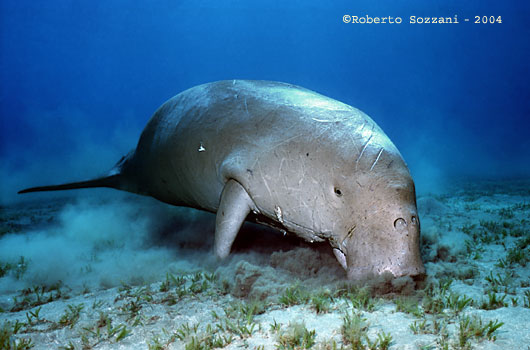
I tried to go slowly and quietly to get near them, but they were a bit shy and scared of my board. I kited near them for 5-10 minutes in shallow water...probably waist deep. They eventually swam off the edge of the reef into deeper water where I lost sight of them. Just before they dove into the deep the bigger one raised his head out of the water with his big long nose and gave me a long hard stare...was he curious, angry or did I interrupt a romantic moment? Maybe he was trying to warn me about the cruel fate in my near future.
The following day, we prepared to leave. We had just a few errands: buy French baguettes, cheese, TimTams (Kai's favorite cookies) and other groceries, check out of the country, and change the oil. Well as usual chores always take longer than you expect. By the time we arrived at the Capitaneria for check out it was 11:15am. The secretary said he was closed from 11am - 3pm for lunch (those French know how to live). But because we wanted to leave, she would do us a favor and see if the Port Captain would interrupt his lunch including his second bottle of wine and give us the formal stamp. The aged Captain shared a few sailing stories, gave us our clearance and returned to open his 3rd bottle.
So finally we returned to Kamaya for the last chore of changing the oil. I've always struggled at changing the oil without making a mess. The problem on a boat is, unlike a car, you can't just open the plug at the bottom and let it drain, because it will all end up in the bilge. So you pump it out the dipstick. I'm usually able to do this without too much mess, but then the oil filter always seems to drip a bit before I get it off. I've experimented with several variations and I thought I'd found the best one. This one involved a little help from Ruthy, which was the fatal flaw. She hadn't given me a birthday present yet and perhaps her mind was thinking about hot oil treatments and massages. Anyway, while I'm leaning into the engine compartment holding the oil pan and guiding the pump hose, she's carefully pumping the oil into a nearly full gallon container. Somewhow, well she's not really sure what happened, but suddenly the container leaped out and hot oil flew right onto my head. My screams of terror awoke the kids who snapped a few photos, but I don't think they really show my big mess and horror. As Maya said, "This might be grounds for divorce."

Well, it's probably very good for my dry skin, but I definitely won't be doing this again in a hurry. Maybe next year I'll get a massage treatment to go along with the hot oil for my birthday. Ruth promised to stay away from the engine, and now with a little distance, we can all laugh at my birthday present. So glad it wasn't as bad as my birthday in 1995 when we lost the mast. Cheers, Tim, the Tin Man with an oil overdose.

The following day, we prepared to leave. We had just a few errands: buy French baguettes, cheese, TimTams (Kai's favorite cookies) and other groceries, check out of the country, and change the oil. Well as usual chores always take longer than you expect. By the time we arrived at the Capitaneria for check out it was 11:15am. The secretary said he was closed from 11am - 3pm for lunch (those French know how to live). But because we wanted to leave, she would do us a favor and see if the Port Captain would interrupt his lunch including his second bottle of wine and give us the formal stamp. The aged Captain shared a few sailing stories, gave us our clearance and returned to open his 3rd bottle.
So finally we returned to Kamaya for the last chore of changing the oil. I've always struggled at changing the oil without making a mess. The problem on a boat is, unlike a car, you can't just open the plug at the bottom and let it drain, because it will all end up in the bilge. So you pump it out the dipstick. I'm usually able to do this without too much mess, but then the oil filter always seems to drip a bit before I get it off. I've experimented with several variations and I thought I'd found the best one. This one involved a little help from Ruthy, which was the fatal flaw. She hadn't given me a birthday present yet and perhaps her mind was thinking about hot oil treatments and massages. Anyway, while I'm leaning into the engine compartment holding the oil pan and guiding the pump hose, she's carefully pumping the oil into a nearly full gallon container. Somewhow, well she's not really sure what happened, but suddenly the container leaped out and hot oil flew right onto my head. My screams of terror awoke the kids who snapped a few photos, but I don't think they really show my big mess and horror. As Maya said, "This might be grounds for divorce."

Well, it's probably very good for my dry skin, but I definitely won't be doing this again in a hurry. Maybe next year I'll get a massage treatment to go along with the hot oil for my birthday. Ruth promised to stay away from the engine, and now with a little distance, we can all laugh at my birthday present. So glad it wasn't as bad as my birthday in 1995 when we lost the mast. Cheers, Tim, the Tin Man with an oil overdose.

Subscribe to:
Posts (Atom)
-
 It all began when we met the four kids on Pickles who were swinging off the side of their boat. They were hooked to spinnaker and jib halyar...
 -
Reentry from living on the ocean to living on land where days include driving cars, talking and texting on the cell phone, unpacking boxes, ...
-
 At 6:30 this morning, our friends on Tyee woke us up with their loud foghorn and a yell, "Kamaya, Kamaya, there's a tsunami warning...